
Pre-Diploma In Information Technology
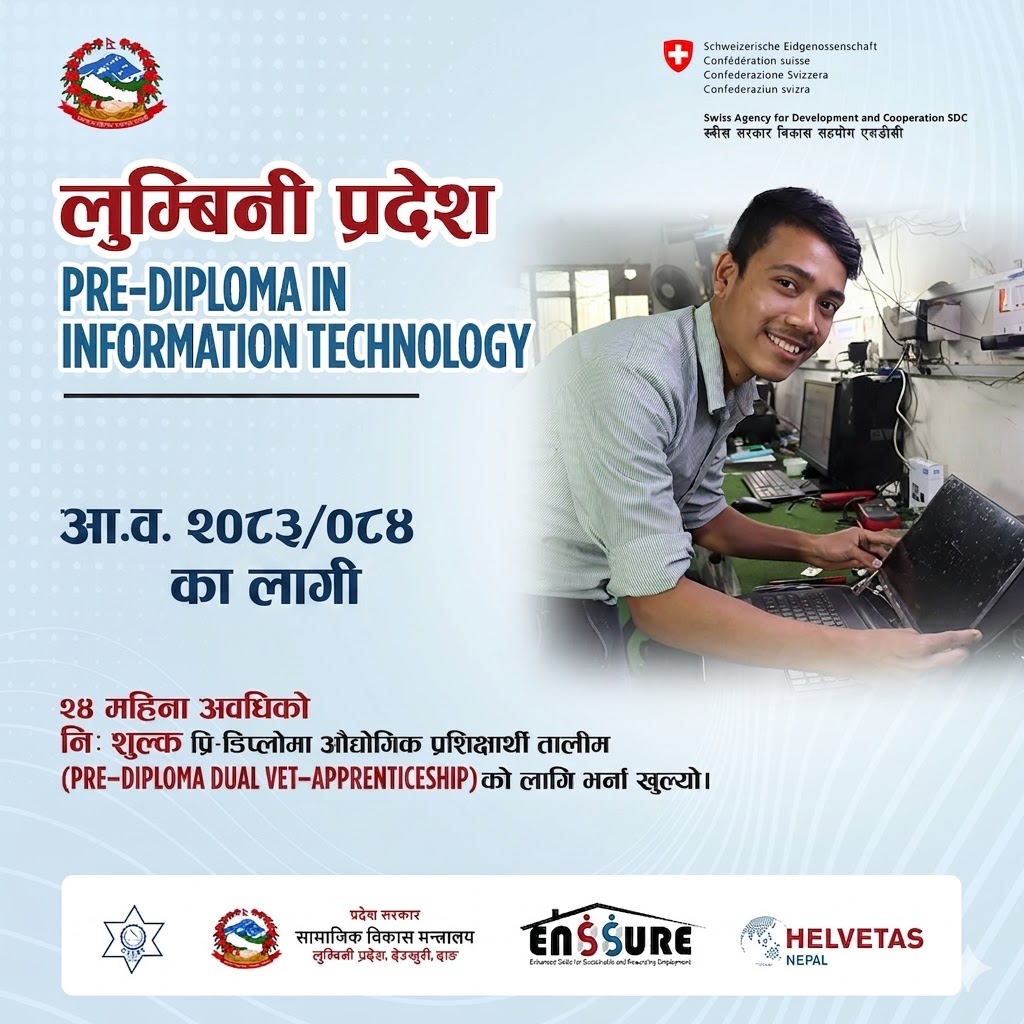
Introduction: TSLC Curriculum in Information Technology is designed to produce entry level workforce. The graduates will be equipped with required knowledge, skills and attitude necessary to this level to meet the demand of the IT industry in the country and aboard. This curriculum is based on the apprenticeship model in which trainees involve in the real industry practice in the industry.An apprenticeship program combines on-the-job training with academic instruction for those entering the workforce. It is also called dual-training programs because of the combined occupational and in-house components; apprenticeships help individuals put their academic skills to practical use in various careers.
The program extends over 24 months. First fifteen weeks in-house classes insist in theoretical and basic practical skills will be provided in training institutes. They learn the theoritical foundational subjects, communications and soft skills. The trainees acquire theoritical knowledge and do practical in the training institutes. In every subject, topical explanations will be followed by demonstrations by instructors and in all tasks, trainees will be asked to practice by themselves through do-it-yourself/hands-on exercises so that they can internalize what they learn in the classroom.
After completing the fifteen weeks classes in training institutes, students are placed in IT industries for 78 weeks (5 days a week and 8 hours a day) for real practice and they are called in training institute for 1 day a week, where they get some theoretical and practical exposure they find necessary. After the completion of 78 weeks' industrial practice, apprentice students come back to the training institute for the revision and exam preparation for 4 weeks as block release.
Admitted trainees will have the three parties training agreement among trainees, sponsor industries and training institute. The Agreement term and conditions will be implemented during the whole training period.
Rationale: Nepal adopted IT policy in 2002 AD. (2057 B.S) and defined the vision, background, objectives and strategies of computer education in Nepal. The main vision of IT policy of Nepal 2002 A.D. is to "Place Nepal on the global map of information Technology". The policy aims at making information technology accessible to the general public and increase employment through this means, builds a knowledge-based society and establishes knowledge-based industries. To achieve the goal, the policy has strategies to promote, facilitate, regulate, develop and expand information technology with a high priority to the participation of the private sector. To cope with the action plan of disseminating IT curriculum formation is the first step. An apprenticeship curriculum prepares graduates apt to the industry need, so that they get employed and poverty will be elevated. Moreover the IT industries have agreed to form the curriculum and train the students as apprentice so that they won't have the scarcity of skilled workers updated with their technologies in low cost.
Course Title: TSLC in Information Technology (Apprenticeship Programme)
Aim: The aim of this programme is to produce competent workforce equipped with IT skills and knowledge to undertake any IT industry, collage or business company.
Objectives: On completion of the course the graduates will be enabled to:
Impart skills and knowledge on performing the job carried out in IT industries.
Handle email, internet and web page
Apply basic IT skills
Design, implement, and reflect on a technology-based project.
Communicate effectively in a variety of professional contexts.
Recognize professional responsibilities and make informed judgments in computing practice based on legal and ethical principles. Analyze user needs and to take them into account in the selection, creation, integration, evaluation, and administration of computing based systems. [IT]
Course Duration: This course will be completed within 24 months after the enrolment in a formal setting. The total hours for the course will be 4378 hours in the 24 months of period. Pre-training course (maximum 15 weeks) and at the last month of the whole course Block Release Training (maximum 4 weeks) programme will be conducted in the Institute. Industrial Practice & related skills will be learnt in the related sponsor industries. The details of the course duration are as follows:
A. Institute Based Instruction: Pre training course: One day/week for 78 weeks: Block Release:
B. Industry Based Training (Hands on Practice): Hardware Assembly, Repair and Maintenance: Networking: Graphic and Web Design: Specialization in Any Department: Entry Criteria: 1258 hours 15 weeks (600 hours) 78 days (498 hours) 4 weeks (160 hours) 3120 hours 12 weeks (480 hours) 12 weeks (480 hours) 12 weeks (480 hours) 42 weeks (1680 hours)
Individuals with following criteria will be eligible for this program:
SEE with any grade and any GPA (Since 2072 SLC).
SLC appeared (Before 2072 SLC).
Nepali citizen above 16 years of age.
Pass entrance examination administered by CTEVT.
Candidates will be recruited on the merit base of entrance examination.
Selected candidates should pass the interview conducted jointly by industry and the training institute.
Mentally & physically sound.
Group size: The group size of this program will be 40. Medium of Instruction:
The medium of instruction will be in English and/or Nepali language. Pattern of Attendance: The students should have 80% attendance in theory classes and 90% in practical/ performance to be eligible for internal assessments and final examinations.
Instructors' Qualification Bachelor's degree in IT or Diploma IT with three years' experience. Preferable Skills: Good communication/instructional skills Experience in the related field Teacher and Student Ratio: Overall ratio of teacher and student must be 1:10 (at the institution level). Teacher and students ratio for theory class should be as per nature of classroom Teacher and student ratio for practical should be 1:10 Minimum 75% of the teachers must be fulltime.
Instructional Media and Materials: The following instructional media and materials are suggested for the effective instruction, demonstration and practical. Printed Media Materials (Assignment sheets, Handouts, Information sheets, Individual training packets, Procedure sheets, Performance Check lists, Textbooks etc.). Non-projected Media Materials (Display, Photographs, Flip chart, Poster, Writing board etc.). Projected Media Materials (Multimedia, Overhead transparencies, Slides etc.). Computer-Based Instructional Materials (Computer-based training, Interactive video etc.) Food commodities, kitchen tools and equipment
Teaching Learning Methodologies: The methods of teaching for this curricular program will be a combination of several approaches such as: Theory: Lecture, group discussion, Assignment, Group work. Practical: Demonstration, Observation and Self-practice, guided practice, tutorial. Industrial Practice: Real practice under the supervision of Industrial Supervisor.
Evaluation Details: The distribution of marks for theory and practical tests will be as per the marks given in the course structure of this curriculum for each subject. Ratio of internal and final evaluation is as follows: S.N. Particulars Internal Assessment 1 Theory Final Exam Pass % 50% 2 Practical 50% 40% 50% 3 Industrial Practice 50% 60% 100% 60% There will be three internal assessments conducted by institute and one final examination in each subject at the end of programme. Moreover, the mode of assessment and examination includes both theory and practical or as per the nature of instruction as mentioned in the course structure. Every student must pass every internal assessment to appear the final exam. Continuous evaluation of the students' performance is to be done by the related instructor/ trainer/industrial supervisor to ensure the proficiency over each competency under each area of a subject specified in the curriculum. Performance evaluation of industrial practice should be done by the related In-company Trainer (Industrial Supervisor). Grading System: The grading system will be as follows: Grading Distinction First division Second division Third division Certificate awarded: Overall marks 80% or above 75% to below 80% 65% to below 75% Pass aggregate to below 65% The council for technical education and vocational training will award certificate of “Technical School Leaving Certificate in Information Technology (Apprenticeship)” to those students who successfully complete the requirements as prescribed by the curriculum. Career Path: The graduate will be eligible for the position equivalent to Non-gazetted 2nd class/level 4 (technical) in the government related organizations or as prescribed by the Public Service Commission of Nepal or the concerned authorities (IT industries) of the Federal Democratic Republic of Nepal.
Our Graduates
AMRITA THARU
Graduated school: Tribhuwan Secondary School , Banke
Occupation: Information Technology
Learning Industry: ATM Infotec Computer Institute
APEKSHYA BANTHA
Graduated school: Tribhuwan Secondary School , Banke
Occupation: Information Technology
Learning Industry: SK Computer Institute
BIMALA B.K.
Graduated school: Tribhuwan Secondary School , Banke
Occupation: Information Technology
Learning Industry: SK Computer Institute
BIMALA KUMARI BUDHA
Graduated school: Tribhuwan Secondary School , Banke
Occupation: Information Technology
Learning Industry: IDS Computer Instiute